Managing inventory and assets is an important part of running any educational institution. From classroom furniture and computers to laboratory equipment, projectors, and sports materials, schools and colleges use hundreds of items every day.
But how many institutions actually know where all their assets are, who is using them, and when they need maintenance?
Many still depend on Excel sheets, paper registers, and manual records. While this may work initially, managing everything manually becomes difficult as an institution grows.
The Problem with Traditional Inventory Management
Imagine a college with multiple departments and laboratories. One department needs a computer, another needs laboratory equipment, and the administration wants to check existing stock before making a new purchase.
Without a centralized system, finding this information can take hours.
Some common problems include:
- Difficulty tracking assets across departments.
- Unnecessary purchases due to incorrect stock records.
- Missing or outdated maintenance information.
- Lack of accountability for assigned assets.
- Time-consuming inventory audits and reporting.
These issues can increase operational costs and create additional work for administrative staff.
How Does Inventory & Asset Management Software Help?
A digital inventory and asset management system brings important information into one place.
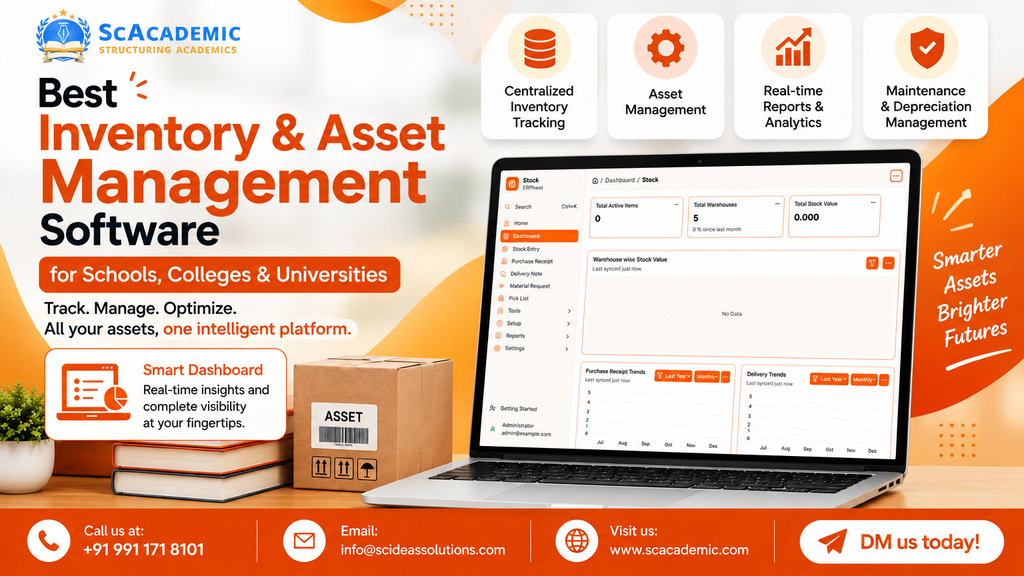
Instead of maintaining multiple registers and spreadsheets, institutions can manage their resources through a centralized platform.
Some useful capabilities include:
1. Asset Tracking: Maintain records of computers, furniture, laboratory equipment, and other assets, including their location and assigned department.
2. Stock Management: Track available stock, purchases, consumption, and item availability to avoid unnecessary procurement.
3. Maintenance Management: Maintain repair history, warranty details, and servicing schedules.
4. Department-wise Allocation: Track which assets are assigned to different departments, classrooms, or laboratories.
5. Reports and Analytics: Generate reports to understand stock availability, asset usage, purchases, and maintenance expenses.
Why Is It Important for Educational Institutions?
Schools, colleges, and universities have different inventory requirements.
Schools need to manage classroom furniture, stationery, computers, and sports equipment.
Colleges need to monitor laboratory equipment, computer systems, library resources, and departmental assets.
Universities may have multiple buildings and campuses, making centralized asset tracking even more important.
A proper digital system helps administrators maintain better visibility and use existing resources more efficiently.
Choosing the Right Inventory Management Software
Before selecting software, institutions should consider a few important things:
- Is it easy for staff to use?
- Can it manage both inventory and fixed assets?
- Does it support multiple departments?
- Are reports and maintenance records available?
- Can it integrate with other ERP modules?
- Can it support the institution as it grows?
The objective should not simply be to purchase software, but to find a solution that makes daily operations easier.
Final Thoughts
Inventory and asset management is not just about maintaining a list of purchased items. It is about knowing what an institution owns, where resources are being used, and how they can be maintained effectively.
Moving from manual records to a digital system can help educational institutions save time, improve accountability, reduce unnecessary purchases, and make better administrative decisions.
For institutions exploring digital solutions, ScAcademic offers an Inventory and Asset Management Module as part of its educational ERP ecosystem.