Transportation is more than just a daily commute—it’s a vital service that keeps educational institutions running smoothly. Whether it’s ensuring school students reach campus safely or providing convenient transportation for college students, faculty, and staff, an efficient transport system contributes significantly to a positive learning environment.
Managing transportation, however, involves much more than assigning buses to routes. Educational institutions must coordinate vehicles, drivers, maintenance schedules, passenger allocations, and route planning while maintaining safety and operational efficiency. Relying on manual processes or disconnected systems can often lead to delays, scheduling conflicts, and unnecessary administrative work.
A modern Transport Management Module, integrated with a School or College ERP System, simplifies these challenges by bringing every transportation activity onto a single platform. It enables institutions to automate daily operations, improve resource utilization, and deliver a safer and more reliable transport experience.
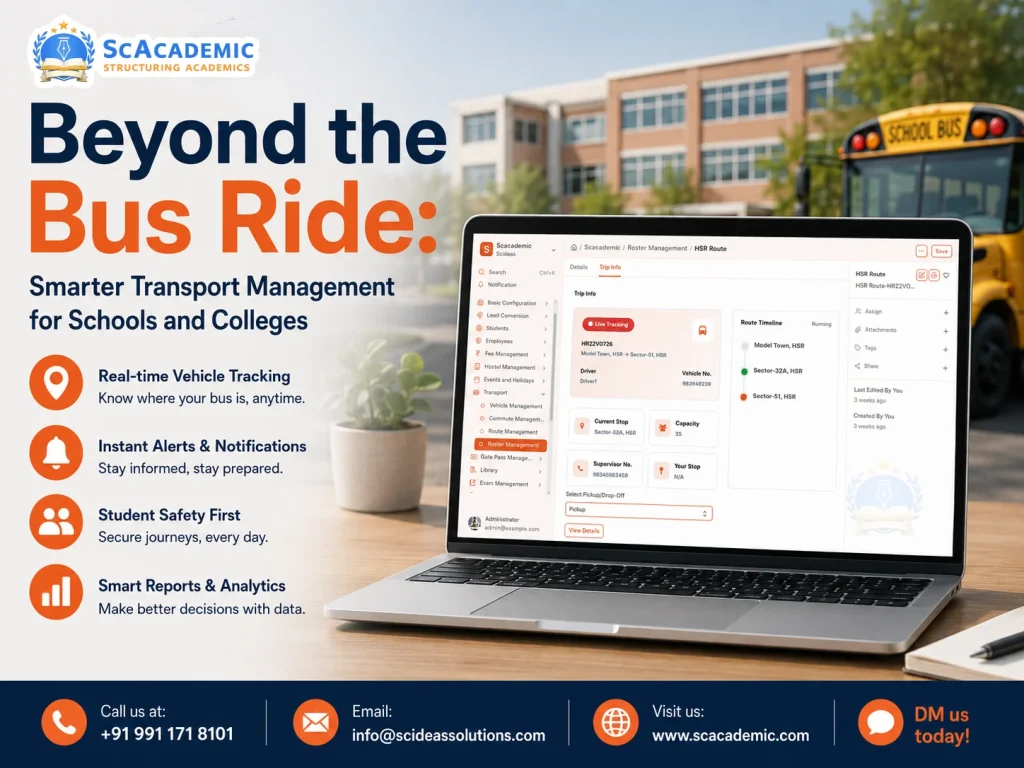
Why Modern Educational Institutions Need Smart Transport Management
As schools and colleges continue to grow, transportation networks become increasingly complex. Managing multiple vehicles, drivers, and routes manually is not only time-consuming but also increases the risk of errors.
A digital transport management system helps institutions streamline transportation by centralizing all operational data. Administrators can efficiently manage vehicle records, assign drivers, monitor maintenance schedules, organize routes, and allocate passengers without maintaining multiple spreadsheets or paper records.
This centralized approach improves efficiency while ensuring transportation operations remain organized and transparent.
Key Features of an ERP-Based Transport Management System
- Vehicle Management : Keeping vehicles in excellent condition is essential for ensuring safe transportation. The system maintains complete records for every vehicle, including registration details, seating capacity, insurance information, fitness certificates, maintenance schedules, and service history. Regular maintenance reminders help institutions schedule servicing on time, reducing unexpected breakdowns and extending vehicle life.
- Driver Management : Drivers play a crucial role in transport safety. The Driver Management feature stores detailed information such as license details, experience, certifications, contact information, and assigned routes. Maintaining organized driver records allows administrators to assign qualified personnel to appropriate routes while ensuring compliance with institutional and regulatory requirements.
- Smart Route Management : Efficient route planning saves both time and operational costs. The Route Management feature enables administrators to create optimized routes based on student pickup points, faculty transportation requirements, traffic conditions, and institutional schedules. Whenever transportation needs change due to new admissions, revised timings, or route modifications, administrators can quickly update routes without disrupting daily operations.
- Passenger and Roster Management : Managing passenger allocation becomes much easier with automated roster management. Administrators can assign vehicles, drivers, and routes while allocating students, teachers, faculty members, and staff according to vehicle seating capacity. This helps maximize vehicle utilization, avoid overcrowding, and maintain accurate transport records for every route.
Benefits of ERP-Based Transport Management
Implementing a smart transport management solution offers numerous benefits for schools, colleges, and universities.
- Enhanced Safety: Well-maintained vehicles, verified drivers, and organized transportation schedules contribute to a safer travel experience for students, faculty, and staff.
- Improved Operational Efficiency: Automation reduces repetitive administrative tasks, allowing staff to manage transportation more accurately and efficiently.
- Optimized Resource Utilization: Better route planning and passenger allocation help institutions maximize vehicle capacity while reducing operational costs.
- Accurate Digital Records: All transportation-related information—including vehicles, drivers, maintenance history, and passenger assignments—is securely stored in one centralized system.
- Better Decision-Making: Comprehensive reports and transport insights enable administrators to monitor operations, identify inefficiencies, and make informed decisions.
Seamless Integration with ERP
One of the biggest advantages of an integrated ERP Transport Management Module is its ability to connect with other institutional functions.
The transport module works seamlessly with student information management, staff management, attendance, fee management, communication, and administrative processes. This eliminates duplicate data entry, improves collaboration between departments, and creates a unified management system for the entire institution.
Whether managing a small fleet or a large transportation network across multiple campuses, the system can easily scale according to institutional requirements.
Building Trust Through Reliable Transportation
Transportation reflects an institution’s commitment to safety and operational excellence. Parents trust schools to provide secure transportation for their children, while college students and employees expect dependable services that support their daily schedules.
An organized transportation system not only improves operational efficiency but also enhances the institution’s reputation by demonstrating professionalism, reliability, and accountability.
Conclusion
Transportation is an integral part of the educational experience, connecting students, faculty, and staff with their institution every day. As educational institutions continue to embrace digital transformation, adopting an ERP-based Transport Management Module has become essential for improving safety, efficiency, and administrative control.
By automating vehicle management, driver records, route planning, passenger allocation, and transportation reporting, schools and colleges can reduce manual effort while delivering reliable transport services. A smart transport management solution empowers institutions to create a safer, more organized, and future-ready transportation system that supports both operational excellence and an exceptional educational experience.