In today’s rapidly evolving educational landscape, colleges and universities are expected to maintain high levels of transparency, academic quality, and regulatory compliance. Managing admissions, student performance, attendance records, and statutory documents manually can be time-consuming and prone to errors. A modern Compliances Module within a College ERP system helps institutions streamline these critical processes while ensuring data accuracy and accountability.
Data-Driven Admission Insights
Understanding admission trends is essential for strategic planning. The Admission Analytics Report enables institutions to track student intake year by year and evaluate enrollment growth over time. By automatically calculating admission conversion rates, administrators can assess the effectiveness of recruitment efforts and make informed decisions to improve future admission cycles.
Comprehensive Academic Performance Monitoring
Academic success is one of the most important indicators of institutional quality. The Student Performance Report provides detailed insights at both individual and institutional levels.
For individual students, administrators and faculty can instantly view pass/fail status and analyze subject-wise performance. This helps identify learning gaps, recognize high achievers, and provide timely academic support where needed.
At the institutional level, the system aggregates performance data across classes and departments, offering a clear overview of pass percentages, subject trends, and overall academic outcomes. These insights support evidence-based decision-making and continuous improvement initiatives.
Smart Attendance Analytics
Attendance is a critical parameter for academic compliance and student engagement. The Attendance Tracking & Analytics Report provides a structured approach to monitoring attendance records.
Users can view attendance data class-wise or student-wise and generate customized reports based on attendance percentages. For example, administrators can instantly retrieve a list of students with attendance below a specified threshold, such as 75%, enabling proactive intervention and compliance monitoring. This feature reduces manual effort and ensures institutions remain aligned with attendance-related regulations.
Centralized Document Management with Version Control
Effective management of regulatory documents is essential for maintaining institutional transparency and accountability.This creates a reliable audit trail while ensuring complete transparency and accountability across document lifecycles. The Document Management Doctype serves as a secure and centralized repository for all compliance-related records.
Documents can be categorized according to regulatory authorities such as AICTE, UGC, or other governing bodies, making retrieval fast and organized. More importantly, the module includes revision and version control capabilities. Whenever a document is updated, previous versions are preserved, creating a complete audit trail. This creates a reliable audit trail while ensuring complete transparency and accountability across document lifecycles.
Driving Compliance Through Digital Transformation
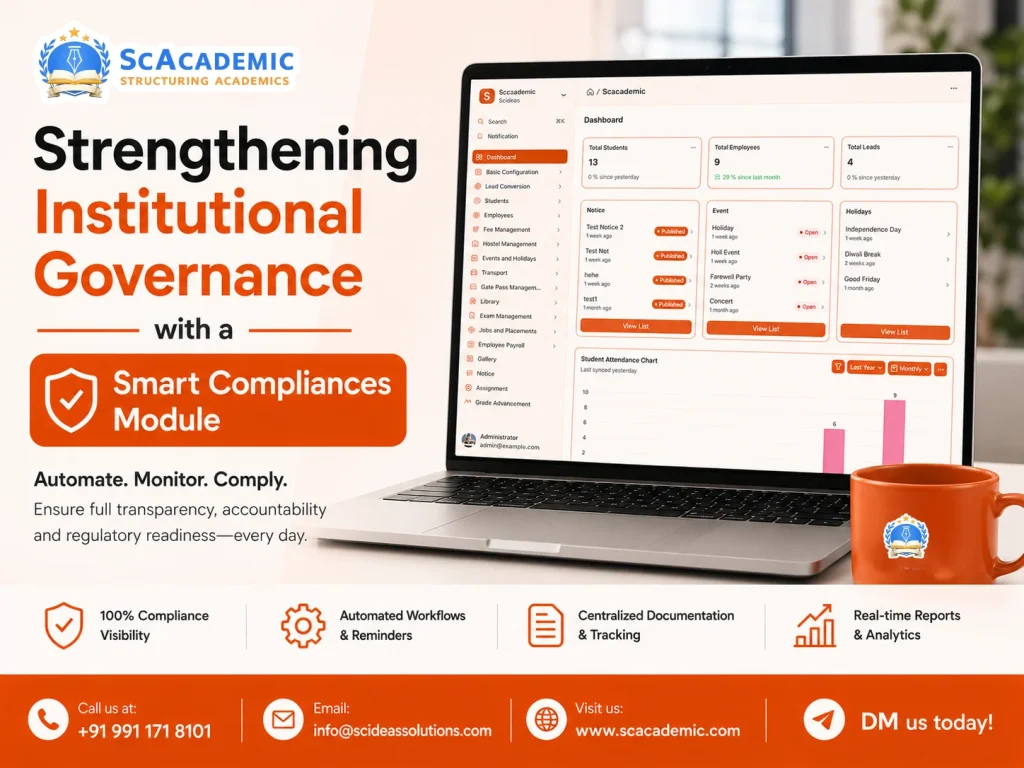
A well-designed Compliances Module does more than store information—it transforms institutional data into actionable insights. By combining admission analytics, academic performance monitoring, attendance tracking, and intelligent document management within a single platform, colleges can improve operational efficiency, strengthen compliance practices, and enhance overall governance.
As educational institutions continue their digital transformation journey, adopting an integrated compliance management system is no longer a convenience—it is a necessity for sustainable growth, regulatory readiness, and academic excellence.
Conclusion
A Smart Compliances Module enables educational institutions to manage compliance requirements efficiently through data-driven insights, automated tracking, and centralized document management. By improving transparency, accountability, and operational efficiency, it helps colleges stay regulatory-ready while supporting informed decision-making, continuous improvement, and long-term institutional growth in an increasingly digital educational environment.