
In today’s competitive education landscape, institutions must go beyond traditional admission methods and adopt a structured, technology-driven approach. A well-designed Student Admission System not only simplifies operations but also enhances transparency, improves conversion rates, and delivers a seamless experience for both students and administrators.
This blog explores how institutions can design a smart student selection process—from initial lead capture to final admission—using modern College ERP and Admission Automation practices.
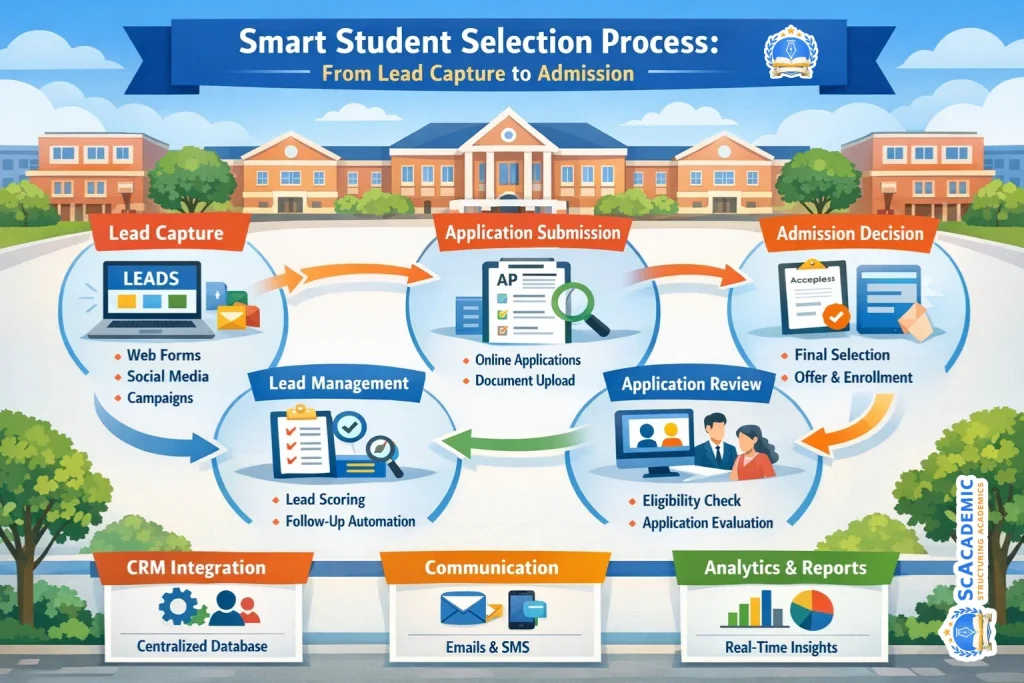
Why a Structured Student Selection Process Matters
A fragmented admission workflow often leads to:
- Duplicate entries
- Lost leads
- Poor communication
- Inefficient decision-making
By implementing a structured system, institutions can:
- Track every applicant journey
- Improve lead conversion rates
- Reduce manual errors
- Gain actionable insights
A well-defined Student Lifecycle ensures that no potential student is missed and every stage is properly managed.
Core Data Model: Lead and Application
At the heart of any smart admission system lies a strong Lead Management model.
- Lead Entity
A Lead represents a prospective student. Each lead should be uniquely identified using:
- Email ID
- Session (academic year or intake)
- Optional: Mobile number for additional validation
2. Application Entity
A single lead can submit multiple applications, such as:
- Applying to different courses
- Reattempting entrance exams
- Applying across different campuses
This one-to-many relationship ensures flexibility and scalability in the system.
Secure Application Retrieval with OTP
Security and ease of access go hand in hand. A smart system allows applicants to retrieve their applications using:
- Email ID
- Session
- OTP (One-Time Password) verification
Benefits:
- Prevents unauthorized access
- Reduces dependency on passwords
- Improves user experience
This approach ensures that students can resume incomplete applications safely and conveniently.
Handling Duplicate Leads Effectively
Duplicate entries are a common challenge in admission systems. A robust solution includes:
Merging Logic:
- Identify duplicates using Email/Mobile
- Merge records into a single Lead profile
- Preserve all associated applications
Duplicate Lead Log:
- Maintain a history of merged records
- Track when and why duplicates occurred
- Ensure audit transparency
This not only cleans your database but also maintains data integrity.
Tracking Lead Source for Marketing Insights
Understanding where your leads come from is critical for improving marketing strategies.
Capture Lead Sources:
- Website forms
- Social media campaigns
- Referral programs
- Offline events
Why It Matters:
- Identify high-performing channels
- Optimize marketing spend
- Improve targeting strategies
Maintaining a Lead Source History allows institutions to make data-driven decisions and boost ROI.
Conclusion
Designing a smart student selection process is essential for institutions aiming to stay competitive in today’s digital-first education environment. By implementing a structured system powered by Student Admission System, Lead Management, and Admission Automation, institutions can eliminate inefficiencies, reduce manual errors, and significantly improve the overall admission experience.
From capturing leads accurately to managing multiple applications, ensuring secure access, handling duplicates, and tracking marketing performance—every step contributes to a more streamlined and intelligent workflow.
Ultimately, a well-optimized College ERP not only improves operational efficiency but also enhances decision-making, increases conversion rates, and builds a strong foundation for the entire Student Lifecycle.
Adopting such a system is not just an upgrade—it’s a strategic move toward smarter, faster, and more reliable admissions.